A school leader's guide for inclusive practices within schools
About this publication
Publication details
Introduction
School leaders are central in making sure that school-wide strategies, policies and initiatives are in place to support the inclusion of students with disability, and to support teachers in providing accessible and inclusive learning environments.
The Disability Standards for Education (DSE) 2005 outlines the obligations for all Australian schools to make sure that students with disability are able to participate in the curriculum, and school activities, on the same basis as students without disability. While this does not mean that every student should have the exact same experiences, it does mean that students with disability should be provided with rigorous, meaningful and dignified learning opportunities and choices.
This guide references the Australian Professional Standard for Principals (Principal Standard) in outlining the roles and responsibilities of school leaders, relevant to the DSE. The Principal Standard creates and promotes a shared vision, clarity of understanding and a common language around effective, high impact school leadership (AITSL, 2019).


Overview
Who is this implementation guide for?
This implementation guide is for school leaders with responsibility for ensuring DSE requirements are embedded within their school.
The guide applies to both ‘senior’ leaders (e.g., principal, deputy principal or those who oversee whole-school improvement strategies), and middle leaders (e.g., faculty coordinator, program leader, who may often balance both teaching and leadership roles). For more information on middle leadership, please see AITSL’s Spotlight: TODO Middle Leadership in Australian Schools.
What is the purpose of the implementation guide?
Positive learning outcomes for all students are supported when inclusive approaches and practices are embedded within a school community. This guide aligns the Principal Standard to school leaders’ responsibilities under the DSE. This guide has been developed in response to Review of Disability Standards for Education: Mapping of teaching and school leadership frameworks to further support whole-of-school leadership with respect to inclusive education. It has been created as an accompaniment to TODO Leadership matrix for senior and middle leaders: Effectively implementing the Disability Standards for Education 2005, a resource designed to help school leaders understand their responsibilities in supporting the inclusion of students with disability, with reference to the five Professional Practices of the Principal Standard. For this guide, we introduce ‘Guiding Values’ as a framework for promoting inclusivity and equity in the school.
The Guiding Values have been developed to support the implementation of the DSE, reflect equity and integrity in schools and provide a leadership focus on improving the experiences of every student. School leaders can adopt these Guiding Values when considering the educational needs of all students. They were developed to reflect a commitment to student equity; the values in the Principal Standard and can apply broadly to any leadership responsibility to improve student experiences and education outcomes.
The Guiding Values are:
- A focus on supporting inclusion of all students in a school community.
- A commitment to strive for equity of opportunity.
- An understanding and consideration of the unique experiences of culturally or linguistically diverse students, and those of Aboriginal or Torres Strait Island backgrounds.
- A zero-tolerance approach to bullying, harassment and discrimination of all students.
- A commitment to regular monitoring and evaluation of the impact of strategies, and continuous improvement.
How can this implementation guide be used?
School leaders should reflect on their own leadership approaches, as well as their school’s strategies and policies to ensure the school is effectively supporting students with disability, and creating a positive learning environment, free of harassment, discrimination and victimisation. Effective school leaders also build understanding and capacity with their leadership team, teachers, and support staff, to provide inclusive learning and teaching practices.
This guide provides:
- detailed descriptions of the responsibilities of school leaders in implementing the DSE, in-line with the Guiding Values.
- questions to help leaders reflect on current practices and how their school approaches inclusivity, to assist in identifying opportunities to improve equity.
- suggested implementation activities and how these may be applied to support students with disability.
- guides for embedding legislative requirements outlined in the DSE within a school’s continuous improvement planning.
Compliance in all aspects of the DSE for teachers and leaders is mandatory, however the approach to enact the DSE may vary between schools based on differing contexts. This may be apparent in terms of leadership capacity, access to disability and allied health support, school strategic plans and priorities and the number of students with disability. It is highly encouraged that school leaders adapt this implementation guide to suit their context and role.
What are the Disability Standards for Education (2005)?
The Disability Standards for Education (DSE) 2005 has specific information for educational settings on the legal obligations of education and training providers, such as schools, under the Disability Discrimination Act 1992. The purpose of the DSE is to ensure that students with disability can access and participate in education on the same basis as students without disability. Schools should be equitable, where all students are given the opportunity to thrive.
The objectives of the DSE are:
- to eliminate, as far as possible, discrimination against persons on the ground of disability in the area of education and training
- to ensure, as far as practicable, that persons with disability have the same rights to equality before the law in the area of education and training as the rest of the community
- to promote recognition and acceptance within the community of the principle that people with disability have the same fundamental rights as the rest of the community.
Making reasonable adjustments
Under the DSE, schools are required to make every effort to provide reasonable adjustments (see Table 1) to support the inclusion of students with disability. This must be undertaken through consultation with students with disability, their guardian/s and associates , and service provider/s (where relevant) to determine reasonable adjustments and implement them where relevant throughout the school.
Reasonable adjustments need to be made by schools in the areas of:
- admissions and enrolment
- participation in learning activities
- curriculum development, accreditation and delivery
- student support services
- harassment and victimisation.
Every school is required to comply with the DSE and make adjustments to the maximum extent that does not impose unjustifiable hardship. Where there is unjustifiable hardship in implementing a specific adjustment, schools should work to find a suitable alternative that benefits the student and meets their needs.
Table 1: What is a reasonable adjustment?
What it is | What it isn't |
|---|---|
For example:
| For example:
|
Examples of reasonable adjustments
| |
Nationally Consistent Collection of Data on School Students with Disability
The Nationally Consistent Collection of Data on School Students with Disability (NCCD) collects data about school students with disability in Australia who are receiving adjustments in a consistent, reliable and systematic way. To aid in the consultation process and implementing reasonable adjustments, the NCCD Portal provides best practice support for schools to help ensure students’ disability related needs are met and that they are supported in their schools.
The NCCD process prompts schools to identify students with disability who are receiving adjustments and to review the school’s processes and practices for supporting students with disability. The NCCD is a record of the category of disability as well as the level of adjustments already undertaken to support students with disability to access and participate in education on the same basis as their peers.
It is important to note that as the NCCD is used to inform funding, the data reported by schools in the annual Non-Government Schools Census is subject to a post-enumeration exercise that validates whether a school’s Census information is accurate, complete and reliable. For more information, including the legislation, policies and lawful requirements on reporting students with disability in the NCCD, please refer to the NCCD Guidelines.
A school is required to:
- Consult with the student with disability, their guardian/s and associates, and/or service providers (when appropriate) to determine their needs and how this may impact learning, participation, and access to all areas of the school (e.g., the classroom, playtime offerings, camps, excursions)
- Understand, where possible, any past adjustments that worked well for the student
- Identify if the adjustments are reasonable given factors such as the positive impacts on the students’ learning, how the adjustment may impact other students and the teacher in the classroom, and the proportion of school resources required
- Consider any other resources or supports available
- Plan for and implement the range of reasonable adjustments.
The needs and requirements of students with disability can change and adapt over time. School leaders demonstrating best practice should ensure that consultations regarding a student’s reasonable adjustments occur frequently with a school leader or teacher who is trained to understand and provide reasonable adjustments, and fully understands their DSE obligations. The whole process of undertaking consultation, consideration and adaptions to the reasonable adjustments (as described above) needs to be regularly repeated to ensure any implemented adjustments are meeting changing student needs.
The DSE require that before the school makes an adjustment for a student, consultation must take place with the student or guardian/associate of the student. Depending on the circumstances, including the student’s home situation, maturity, and cognitive ability, it may be suitable to only consult with the student or only with their guardian/s and associates. The school leader or teacher can determine what is best for consultation and will need to provide a reason for not consulting with the guardian/s and associates, as required by the NCCD Guidelines.
Under the DSE, there may be instances where a school must demonstrate an exception is required where the adjustment is believed to cause unjustifiable hardship. Unjustified hardship is when complying with the DSE imposes an excessive burden on the education provider, staff or other students. It is the responsibility of each school to demonstrate if an exception occurs.
Harassment, victimisation and discrimination
In addition to making reasonable adjustments for students with disability, schools have an obligation to prevent harassment, victimisation and discrimination of all students, including those with disability, or those who have a guardian or associate with disability. For the purposes of the DSE harassment, in relation to disability can be defined as any action that results in a student with disability (or with an associate with disability) being humiliated, offended, intimidated or distressed because of their disability.
School leaders need to ensure that the school has strategies and programs in place to prevent harassment and victimisation and to keep staff and students informed about:
- their obligations not to harass or victimise anyone in the school, especially those vulnerable to discrimination and victimisation due to disability
- the actions that will be taken if harassment or victimisation occurs
- the complaint mechanisms available to a student who is harassed or victimised in relation to a disability.
Aligning the Guiding Values with the DSE
A focus on supporting inclusion of all students in a school community
Inclusion occurs when everyone feels they belong. Inclusion can be defined as a human right, a legal entitlement to all, and a key aspect of educational policy. Highly effective and impactful school leaders embrace inclusion, inspire their staff and students to achieve more, and consider their school community, education systems and sectors. Inclusion is demonstrated within school communities when all students feel safe, valued, heard, and known.
For students with disability, inclusive school values, teaching behaviours and positive student culture is especially important for their wellbeing and sense of belonging.
Consider the following questions related to this guiding value
Reflecting on current state
- Does the school enable the inclusion of students with disability?
- What are our school strategies, policies and approaches to inclusivity? Are these reactive or proactive?
- What are we currently doing at the school to make it welcoming and inclusive to both prospective and current students?
- Are our leadership team taking an inclusive view to school management?
Thinking about future state
- What can be done from enrolment through to transition to provide an inclusive induction into and ongoing participation in the school?
- How can we foster inclusivity amongst students to provide a positive student culture and foster diverse friendships?
- How can students’ guardian/s and associates be further involved to support and advocate inclusion not just for their child, but for all students and other families?
- How can we advocate our inclusive practices to make our school feel like an attractive, welcoming and safe environment for current and prospective students and their families?
- How can we advocate for inclusivity with the wider community? What can positive and inclusive relationships with the school community do for the school?
- How can the community become advocates for students with disability?
Consider the following ways to implement this guiding value
Behaviours
- Be a role model for inclusivity and demonstrate this in all interactions with staff, students, their guardian/s and associates, and the wider school community.
- Engage with the wider community and consistently advocate for inclusivity; demonstrate a zero-tolerance approach towards bullying, harassment and discrimination.
- Celebrate the accomplishments of all students in a way that is inclusive of students with disability.
Communication
- Recognise the unique experiences of students with disability and form strong positive relationships with the student and their guardian/s or associates; invite open conversations around their needs.
- Make it apparent to students and their guardian/s that communication is open and you welcome any opinions and suggestions around building a more inclusive school.
- Proactively engage and consult with students with disability; provide ample opportunity for them to be seen, heard and considered.
- Ensure that all information provided to prospective students reflects inclusive practices and ensures all students feel welcomed.
Collaboration
- Collaborate with parent/carer communities to strengthen and advocate the school’s inclusivity practices.
- Collaborate with students, their guardian/s and associates, to identify the student needs and determine adjustments or improvements to adjustments together.
Education
- Educate teaching and support staff on their role in making a student feel they belong. Communicate ways in which teachers can actively engage with their students to make them feel seen and heard.
- Maintain understanding of all legislative responsibilities, and school-level policies, procedures and codes of conduct (related to inclusive education) and make sure all staff understand their responsibilities under the DSE.
Leading ethically – tips on how to demonstrate inclusive behaviours
Leading ethically requires active learning and frequent reflection to improve personal and team behaviours. Some ideas to improve personal practices include:
- Be fair - treat everyone within the school community fairly by providing equal opportunities.
- Foster trust - establish trust with all staff and students, making people feel safe and willing to contribute their ideas.
- Lead by example - model the types of behaviours you want to see from others.
- Be curious – ask questions and seek to deepen your understanding of students, their guardian/s and teachers.
- Practice active listening - when interacting with different cohorts of students and staff, you create a psychologically safe environment, and a platform to ensure ideas are heard.
- Be self-aware – understand your own conscious and unconscious biases and have strategies in place to help mitigate these.
- Articulate your expectations – clearly communicate the values and behaviours expected of the entire school community, including demonstrating respect and inclusion of students with disability.
- Address issues – in instances where you see behaviours that you do not feel are best supporting the inclusion of students, provide feedback and coaching to help the staff or students involved to understand what is expected. Serious matters related to harassment or victimisation of students with disability must be dealt with through the school’s formal channels.
A commitment to ensure equity of opportunity for all students
Effective school leaders are committed to providing equal opportunities to their students, to maintain fairness and equity. School leaders need to take the time to understand the unique experiences and needs of their students and collaborate with all staff to ensure every student is appropriately supported.
For students with disability, school leaders demonstrate commitment to equity by endeavouring to understand and implement a range of reasonable adjustments to cater to a student’s needs and allow them to participate fully in their learning and extra-curricular activities.
Consider the following questions related to this guiding value
Reflecting on current state
- Does our school’s teaching and learning pedagogy and strategies support equal opportunities for all students?
- What consultation procedures are currently in place to learn more about students’ needs?
- What learning opportunities are available to teachers to better understand the needs and experiences of students with disability?
- What training is provided to teaching staff to observe students and initiate a referral if needed?
- Are our school’s facilities flexible to support adjustments that enable the inclusion of students with disability?
- What are our school’s universal, targeted and specific interventions currently implemented in the school, and what more is available to be introduced into the school?
- Do students and their guardian/s or associates currently feel like they can voice their needs and suggestions openly with our teachers and leadership staff? If not, why, and how can this be improved?
- Are there strong complaint mechanisms in place to alert our school leaders of changes needed to improve the equality and inclusivity of all students?
Thinking about future state:
- How can we better inform and support teachers to consult with students and adjust their teaching practice to support students with disability?
- Are there opportunities to make use of new technologies to enhance teaching practices and support the inclusion of all students in learning?
- How can we effectively keep inclusive, adjusted teaching and learning approaches top-of-mind when inducting new staff to the school?
- How can communication be improved with students and their guardian/s or associates so they can voice their needs and suggestions openly with teachers and leadership staff?
Consider the following ways to implement the guiding values
Behaviours
- Ensure our leadership team, teachers and support staff are committed to student consultation and understand the needs of students in all aspects e.g., intellectually, behaviourally, and physically.
- Ensure effective programs, activities and extra-curricular activities are developed so reasonable adjustments can be made.
- Arrange for service provider/s to be made available through the school to assist students with disability, where reasonable.
- Make sure any school-wide changes that strengthen inclusivity are consistent with the school vision, purpose and strategy.
Education
- Provide professional learning to teachers to better understand disability and identify where additional needs may be required.
- Implement any education or communication strategies to teaching staff in order to strengthen their ability to consult with students and their guardian/s and associates, understand the needs of students, and adjust teaching and learning practice.
- When inducting new teachers, ensure they understand the shared vision of inclusive practice and are informed of consultation procedures and strategies for implementing reasonable adjustments.
Communication
- Establish an accessible communication channel for students, guardian/s and associates, and all staff to voice their needs, opinions, and suggestions for more inclusive learning.
- Determine consistent consultation protocols between leadership, teachers, students and their guardian/s and associates, to determine where adjustments need to be made in teaching practices and the school’s facilities, including enrolment, transitions between classes at school and attendance.
- Make sure teachers are aware of reasonable adjustments and what is available to support their teaching practice further (e.g., teacher assistants, resources, etc).
Evaluation
- Use multiple forms of data and consultation to determine any blockers or barriers to the DSE and the Guiding Principles being implemented.
Consulting with students with disability to inform reasonable adjustments
School leaders have a responsibility to ensure that teachers are consulting with students with disability (and guardian/s and associates where appropriate) to inform reasonable adjustments for elements such as curriculum, teaching practices and teaching facilities.
School leaders and teachers are required to accurately record, report and provide evidence of student disability nationally in-line with the NCCD (with some exceptions2). It should be noted that the NCCD relies upon existing evidence and does not require the generation of additional evidence created specifically for the purpose of including a student in the NCCD. Evidence that at least 10 weeks of adjustment(s) (cumulative) have been provided to the student (in the 12 months preceding Census Day) to address their assessed individual needs associated with disability and evidence to justify the level reported is required.
School leaders should consider school-based internal records to share with the student’s teachers between grades, so any adjustments are consistently applied and adapted throughout the student’s school journey.
Information to record for internal reporting may include some of the following:
- Student’s name and student guardian and associate’s contact details (if applicable)
- The adjustments provided, and from when (including past adjustments)
- The level of adjustment (e.g., differentiated/minor – extensive)
- Details of the category of disability (physical, cognitive, social-emotional or sensory)
- Required adjustments to extra-curricular and other school-based activities
- Options for alternative activities that may be suitable for the student and are equitable.
Support tools and interventions
There are several important mechanisms that schools should put in place to support students with disability, to ensure their individual learning needs are met, and they are able to engage in learning on the same basis as their peers. These resources should be utilised throughout a student’s time at the school, including during the admission and enrolment process, where required and possible.
Examples of these include:
- Student Support Group – typically includes the student with disability, their guardian and associates, teacher, teacher’s aide, service providers (where appropriate), and school leadership representative. This group may meet regularly to discuss the needs and goals of the student as they progress through their education.
- Individual Education Plan (IEP)/Personalised Learning Plan (PLP)/Reasonable Adjustment Plan - describes personalised learning and support strategies including adjustments that are put in place for students with additional needs.
- Response to Intervention (RTI) - a schoolwide framework used in many contexts to facilitate the monitoring and reviewing process for students with persistent learning difficulties and disabilities. The RTI process focuses on the relationship between teaching methods, effectiveness and student outcomes.
- Assessment tools – there are many high-quality assessment tools available to help teachers assess and identify the needs of their students. These are often available online on a jurisdiction-basis and can likely be found at relevant jurisdiction websites.
More examples of support, resources and tools can be found at TODO ‘Inclusive Education: Teaching Students with Disability’ (AITSL, 2020)
Scenario: Imputing Disability
Identifying and understanding the needs of each individual student is integral to fostering a safe, valuable learning experience – regardless of abilities. As an educational provider, being able to understand the unique needs of students who may otherwise struggle without support is vital to giving those students equal opportunity to receive a quality education.
In some instances, a ‘school team may impute disability when they believe, based on reasonable grounds and supported by documented evidence, that undiagnosed disability is having a functional impact on the student’s capacity to access and participate in education on the same basis as their peers. School teams may impute disability based on the DDA definitions, and, for the purposes of the NCCD, describe the disability in terms of the four broad categories: physical, cognitive, sensory or social/emotional’. (NCCD, Imputing disability for the NCCD, 2021) For more information and guidance to schools on imputing disability, refer to the NCCD website.
Key consideration of the unique experiences associated with being culturally or linguistically diverse, and of Aboriginal or Torres Strait Island backgrounds
School leaders must always consider the unique experiences associated with coming from a culturally or linguistically diverse background or being of Aboriginal and Torres Strait Islander descent.
There can be different understandings and responses to disability within varying cultural contexts and therefore students and families may require additional or tailored supports, resources and flexible communication methods. Importantly, school leaders need to ensure that culturally diverse, Aboriginal and Torres Strait Islander students with disability are not bullied or discriminated against based on their disability, cultural differences and indigeneity.
Leaders are critical to fostering a whole-school and community culture that understands these unique challenges and endeavours to provide a welcoming, respectful, safe and inclusive school environment.
Consider the following questions related to this guiding value
Reflecting on current state
- What professional learning do we offer to all staff to build intercultural development in addition to disability understanding?
- What are our leadership and staff doing to self-reflect and address bias towards culturally diverse and Aboriginal and Torres Strait Islander students with disability?
- Do culturally diverse students with disability currently feel valued and included in our school?
- What are our leadership team and teaching staff doing now to openly communicate with students’ guardian/s, associates and/or community members from diverse backgrounds, in order to hear their opinions, suggestions and recommendations for reasonable adjustments?
- What additional supports are available or needed (such as a translator) to consult with culturally diverse students and their guardian/s or associates when planning reasonable adjustments?
- How are we currently working to ensure culturally diverse or Aboriginal and Torres Strait Islander students with disability are not falling through the educational gaps?
Thinking about future state
- How can teaching staff be supported to offer flexible classroom teaching and learning that considers students’ abilities, and diverse cultural, linguistic backgrounds?
- How can our leadership team demonstrate and model examples of a positive, inclusive culture?
- How can our leadership team ensure reasonable adjustments are available in ways that also foster cultural connectivity and inclusion?
- What can we do to build relationships with all in the community in a way that fosters a sense of belonging for culturally diverse students with disability?
- What other supports could be offered or implemented that can cater to both disability needs and linguistic/cultural needs?
- What more needs to be done to ensure culturally diverse or indigenous students with disability are not falling through the educational gaps?
Consider the following ways to implement the guiding value:
Behaviours
- Develop, communicate and practice a strong vision that focuses on the inclusion of all students in the school community; celebrate all student achievements and find opportunities to educate them on diversity.
- If available and accessible, ensure appropriate use of additional cultural/linguistic support for student and/or guardian/s/associate consultation on reasonable adjustment – e.g., a translator.
- Build a culture of inclusion within the school community, by modelling exemplary ethical behaviour and celebrating the accomplishments of all students.
- Authentically demonstrate advocacy for students with disability and remain aware of your own biases towards cultural diversity.
- Support teaching collaboration and innovation to cater to the unique needs of culturally diverse students with disability.
Education
- Provide communication and education to all staff to inform of the unique challenges for students with both a diverse background and disability; educate leaders and teachers on the importance of preventing and addressing discrimination.
- Make available culturally and/or linguistically appropriate information on disability resources for guardian/s and associates.
- Find opportunities to include and educate the school and wider community in culturally or country important celebrations, e.g., NAIDOC week, Diwali, Ramadan, etc.
- Educate all staff on bias and ways to overcome their own bias towards cultural diversity.
- Provide opportunities for guidance and coaching for all staff and encourage them to pursue professional learning that can help build capabilities in inclusive practices and overcoming inequity.
Tips for communicating effectively with students with a disability from diverse backgrounds
In some cultures, including Aboriginal and Torres Strait Islander cultures, for cultural and historical reasons there is limited understanding of disability, and people with disability may not identify as having disability. At times, this can mean that as students with disability commence their school learning, they and their guardian/s and associates have limited awareness of disability or the supports they may need to participate at school on the same basis as children without disability.
To effectively support students with disability from diverse backgrounds, it is important to tailor your communications approach appropriately. Some approaches to support high quality communications with students with disability from diverse backgrounds, and their guardian/s and associates, include:
- Building a positive relationship with the student and their guardian/s and associates to understand their needs and concerns
- Offer opportunities for face-to-face conversations, supplemented by written resources, to provide additional information for ongoing reference
- Invite questions to be asked to seek clarification or confirm understandings
- Make available translators to support those from culturally and linguistically diverse backgrounds, as well as access to resources translated to other languages
- Make available translators to support those from culturally and linguistically diverse backgrounds, as well as access to resources translated to other languages
A zero-tolerance approach to harassment, victimisation and discrimination of all students
While there continues to be a push for inclusive learning and safe school environments, students with disability can be targeted when it comes to harassment, victimisation and discrimination; this can have a negative effect on the student’s wellbeing, belonging and ability to engage in their learning at school.
Leading an inclusive and welcoming school culture, where there is a zero-tolerance approach to bullying and harassment, can help in the recognition and acceptance of students with disability, and foster a sense of belonging, safety, and opportunity to learn. Strong leaders, as influencers of the community, should be advocates for zero-bullying of students with disability, and work with the community to become more accepting.
Consider the following questions related to this guiding value
Reflecting on current state
- What are the current mechanisms in place to handle complaints and concerns around bullying?
- What are the current protocols in place to avoid, or resolve, instances of bullying and harassment?
- How are extreme cases of bullying handled? What more needs to be done to reduce this?
- How are victimised students supported and consulted to ensure their safety and wellbeing?
- What are the policies and legislative requirements in place for bullying? How can all leaders and school staff be made aware of these, and keep them front-of-mind?
Thinking about future state
- How can we give a greater voice to students with disability, and their guardian/s and associates, to ensure their concerns and complaints are heard?
- What can we do to reduce and ultimately remove instances of harassment and victimisation of students with disability?
- How can students be empowered to build a welcoming, accepting school culture and advocate for disability and diversity?
- What can the wider school community do to foster a zero- tolerance approach to bullying?
Consider the following ways to implement the guiding value:
Behaviours
- Collaborate with teachers to build knowledge and understanding of the school’s strategies to prevent harassment or victimisation of a student with disability.
- Empower students through representative councils or educational initiatives to allow students to demonstrate advocacy and gain a greater understanding of the diversity of their peers.
- Engage effectively with support and service provider/s e.g. school psychologists.
Management of the school
- Implement school policies, procedures and codes of conduct that explicitly prohibit harassment and victimisation of students with disability.
- Establish rigorous, strong systems for receiving and alleviating cases of harassment and discrimination.
- Develop admissions and enrolment policies and procedures that ensure zero discrimination towards prospective students with disability regarding their inclusion in the school.
- Implement the system and legislative requirements in place to protect all students from bullying and harassment; support teachers to understand new implementations and their role in strengthening equity.
Communication
- Build respectful relationships that welcomes open conversation and collaboration. Establishing this with students and their guardian/s and associates prior to enrolment creates a safer and more positive induction into school, especially with the potential of increased chances of discrimination.
- Ensure the school community are informed of their obligation to support student inclusivity, with no tolerance for harassment of students with disability.
Education
- Educate all students and staff on their rights and responsibilities in maintaining an environment free from harassment and victimisation based on disability.
- Ensure the leadership team are supporting teachers in facilitating/participating in Program Support Group (PSG) meetings when required
A commitment to regular monitoring and evaluation of the impact of strategies, and continuous improvement
School leaders’ commitment to regularly monitoring and evaluating of the impact of strategies that drives continuous improvement is integral to effectively manage a school implementing the DSE. Through the leaders’ pursual of continuous improvement, all staff are imparted with a sense of high expectations and are aware of the school’s commitment to provide equitable education for all students.
Continuous improvement is aided by trust and empowerment of all staff to contribute to the school’s growth through a positive professional culture. When teachers collaborate and undertake professional learning, with the aim of enhancing their practice, they contribute to the whole-school ability to cater to the needs of all students, including those with disability.
To successfully implement the DSE, school leaders need to strongly consider each element of the DSE in all aspects of school improvement planning and seek opportunities to collaborate with the school community to drive inclusive innovation and change.
Consider the following questions related to this guiding value
Reflecting on current state
- What are we doing to ensure the school meets its legislative requirements under the DSE?
- Do our school values underpin and support high-quality inclusive practices and set expectations that all activities are focused on improving student learning outcomes?
- Is a growth mindset, guided by the objectives of the DSE, demonstrated by our leadership team and successfully imparted on all staff?
- What current measures are in place to learn what is working well and what could be improved in implementing the DSE? What more should be done to determine a holistic view of our school?
- Are guardian/s, associates and parent and carer communities engaged to contribute to our whole-school improvement and innovation strategies, especially in making inclusive changes?
- Do our teachers feel empowered to work together, and with our leadership team, to enact changes that continually improve implementation of the DSE? What more could be done to enhance this?
- How is our school’s context considered when planning change, particularly in relation to support of students with disability?
- Is leadership shared and delegated (where possible) to provide diverse ideas and observation in school improvement and implementing the DSE?
Thinking about future state:
- How can improvement opportunities for inclusive education practices, support interventions and school culture be identified within the school?
- How can a clear alignment between vision, strategy and implementation be ensured to make sure the DSE is effectively considered?
- Are there opportunities to make use of new technologies to enhance our school monitoring, reflection and planning, to support the inclusion of all students?
- How can we improve school planning, implementation and monitoring to quickly and accurately understand what inclusive strategies are working well or not?
Consider the following ways to implement the guiding value:
Behaviours
- Provide leadership support for all teachers and support staff to ensure that curriculum design and pedagogical approaches support inclusion in teaching and learning; uplift and empower teachers to understand and respond to the needs of students through individualised learning.
- Foster a growth-focused, inclusive culture and provide teachers and support staff ample opportunity to collaborate in teaching practice. Ensure two-way communication between leaders and teachers on observations and ideas for improvement opportunities.
- Remain curious and challenge the status quo; always seek a holistic understanding of the current state and consider all perspectives.
Collaboration
- Allow all within the school community to contribute to change, innovation and improvement for students with disability or culturally diverse backgrounds, and establish an accessible communication channel for these conversations.
- Encourage staff to contribute to education networks, to share ideas on implementing the DSE, and support professional collaboration on inclusive practices across districts/networks.
- Leverage parent and carer communities to understand improvement opportunities and receive suggestions for strengthening equity.
- Leverage student representative councils to incorporate student voice and gain ideas to uplift equity; empower all students to assist in promoting an inclusive culture and creating a positive classroom environment.
Evaluation and monitoring
- Use multiple forms of data and consultation to assess, reflect, improve and monitor any initiatives aimed at improving equity and supporting students with disability.
- Determine consistent consultation protocols between leadership and teachers with students and guardian/s and associates to determine where adjustments need to be made in teaching and the school’s facilities, and follow-up to keep accountable to any changes, ensuring real improvements are being made.
- Use a range of data sources to determine the state of the school’s practice and implementation of the DSE.
- Understand the context and community of the school when introducing new changes that better align with the DSE; consider how they might react, how they can be involved, or what might need to be communicated.
- Ensure processes and reporting mechanisms are in place that support consistent and frequent consultation with students with disability and their guardian/s and associates to receive feedback, ideas and improvement opportunities.
- Refer to the NCCD Guidelines for the year and other relevant state policy on data reporting.
- Systematically monitor and report on student learning progress and have interventions in place to reduce educational gaps; determine how effective these interventions are, and how they could improve.
Incorporating the voice of those with lived experience
To effectively inform key decisions to support students with disability, it is vital for school leaders to consult with, and seek feedback from those with experience of living and learning with disability. Some strategies you may wish to implement in your school include:
- Regularly consulting with students with disability on their experiences at the school, and suggested ways for enhancing the inclusion of all students (for example through one-on-one interviews or focus groups)
- Requesting feedback and suggestions from the guardian/s and associates of students with disability (for example through teacher-led discussions with guardian/s and associates, annual survey)
- Asking teachers for their reflections on the reasonable adjustments put in place within the school to support students with disability, and whole-of-school strategies to improve practices (which should feed into the school’s improvement plan)
- Seeking input from service provider/s who work closely with students with disability in the school
- Seeking feedback from relevant governance groups in the school through annual meeting agenda items regarding the school’s inclusive practices and opportunities for improvement
- Requesting advice and resources from relevant associations or support groups that provide advice to support those living with disability.
Implementation
All changes to improve the implementation of the DSE – big or small – require a consistent commitment to reflection and adaption from school leadership.
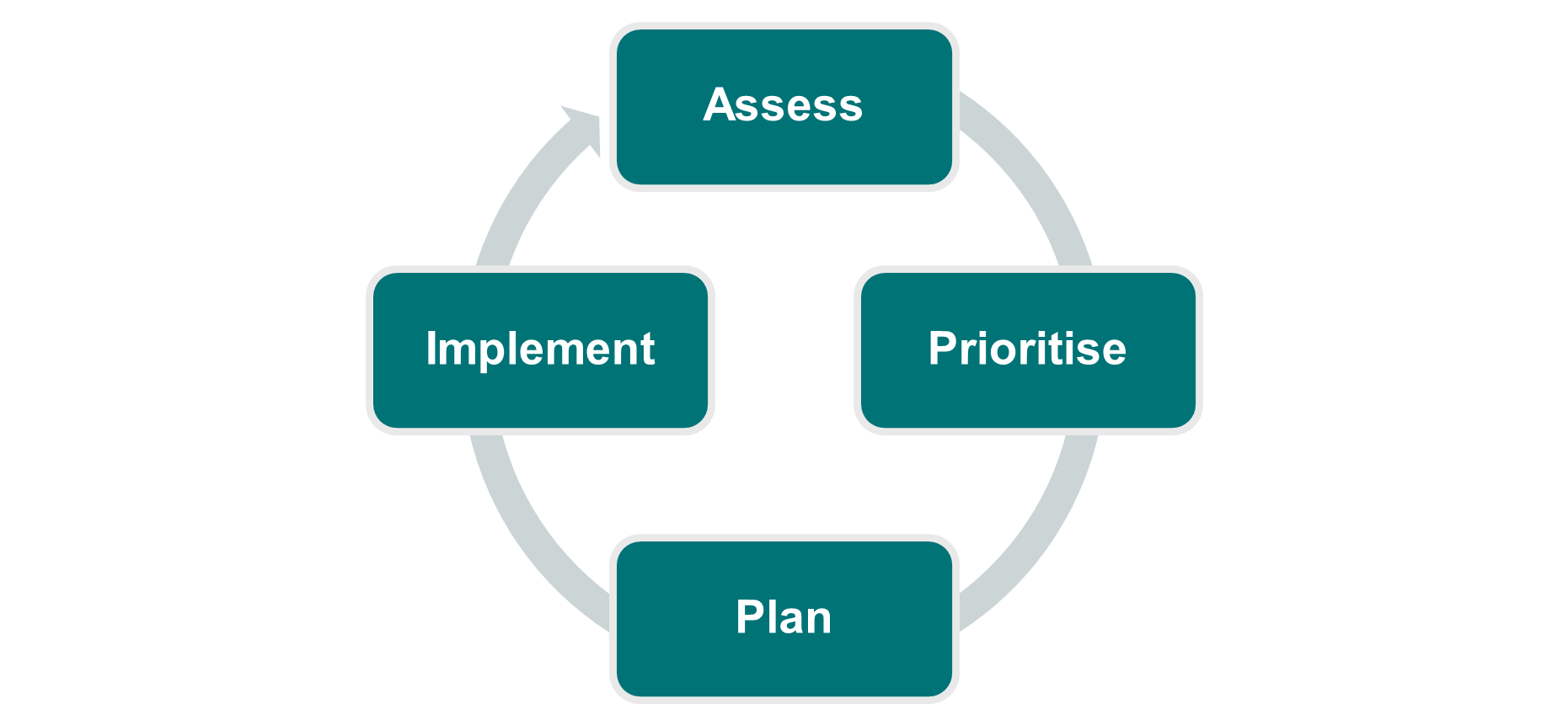
To implement effective practices that can improve the student experience, learning outcomes and strengthen equity, there is typically a cycle of key stages; many jurisdictions provide a small set of stages within a similar cycle to as follows (see Figure 2).
- Assess: evaluate areas where inclusivity and opportunity are inadequate, where harassment or discrimination is present within the school, where the legislative requirements need to be embedded, and determine areas of improvement.
- Prioritise: determine changes required throughout the school, prioritise actions that will create the most impact on learning and wellbeing, and set goals for what needs to be achieved.
- Plan: develop plans, initiatives and strategies in a way that will allow for measurement, accountability, buy-in and successful implementation. Consider all available resources, such as teaching or support staff, school facilities and students’ guardian/s and associates.
- Implement: after making changes, monitor progress and the impact on students, so prompt responses can be made, and strategies can be adapted.
Final remarks
This guide provides core guiding values to assist school leaders in implementing the DSE and support the provision of high-quality education that all students are entitled to receive. The Guiding Values were developed to reflect the student-centric vision and mission as demonstrated in the Principal Standard and can be broadly applied to all facets of school leadership and the profession of teaching. These Guiding Values provide a strong framework for leaders to understand, reflect and take action to incorporate the DSE in their roles and responsibilities, through reflective questions, key initiatives and practical examples.
Leaders who implement the DSE throughout all aspects of their school can foster a positive, inclusive culture that advocates acceptance and equity. If students with disability are provided with equal opportunities with students without disability, the greater the prospects are for all students to grow and thrive from receiving a quality education.
Where can I find out more?
- Australian Curriculum, Assessment and Reporting Authority.(n.d.). Meeting the Needs of Students with a Disability. https://www.australiancurriculum.edu.au/resources/student-diversity/meeting-the-needs-of-students-with-a-disability/
- Australian Disability Clearinghouse on Education and Training. (n.d.). Inclusive Teaching, Working with Students: Communication Tips.https://www.adcet.edu.au/
- Australian Institute for Teaching and School Leadership. (2014). Australian Professional Standard for Principals and the Leadership Profiles. https://www.aitsl.edu.au/docs/default-source/national-policy-framework/australian-professional-standard-for-principals-and-the-leadership-profiles
- Australian Institute for Teaching and School Leadership. (2019). Middle Leadership in Australian Schools. https://www.aitsl.edu.au/research/spotlights/middle-leadership-in-australian-schools
- Australian Institute for Teaching and School Leadership. (2020). Inclusive Education: Teaching Students with Disability. https://www.aitsl.edu.au/research/spotlights/inclusive-education-teaching-students-with-disability
- Australian Institute for Teaching and School Leadership. (2022). Building a Culturally Responsive Australian Teaching Workforce. https://www.aitsl.edu.au/teach/intercultural-development/building-a-culturally-responsive-australian-teaching-workforce
- Australian Institute for Teaching and School Leadership. (n.d.). Teacher Standards.https://www.aitsl.edu.au/standards
- Australian Institute for Teaching and School Leadership. (n.d.). Unpack the Principal Standards.https://www.aitsl.edu.au/lead-develop/understand-the-principal-standard/unpack-the-principal-standard
- Australian Institute of Health and Welfare. (2022). People with disability in Australia, Engagement in Education. https://www.aihw.gov.au/reports/disability/people-with-disability-in-australia/contents/education-and-skills/engagement-in-education
- Commonwealth of Australia. Disability Standards for Education 2005. https://www.legislation.gov.au/Details/F2005L00767
- Commonwealth of Australia. Disability Discrimination Act 1992. https://www.legislation.gov.au/details/c2013c00022
- Commonwealth of Australia. Nationally Consistent Collection of Data on School Students with Disability: 2023 Guidelines. https://www.nccd.edu.au/sites/default/files/2023_NCCD_Guidelines.pdf
- Department of Education. (2020). Disability Standards for Education 2005, 2020 Review. https://www.education.gov.au/disability-standards-education-2005
- New South Wales Department of Education. (2017). School Excellence Cycle. https://education.nsw.gov.au/teaching-and-learning/school-excellence-and-accountability/school-excellence-in-action/school-improvement-and-excellence/the-school-excellence-cycle
- New South Wales Department of Education. (2022). Disability Standards for Education. https://education.nsw.gov.au/teaching-and-learning/disability-learning-and-support/personalised-support-for-learning/disability-standards-for-education#:~:text=Under%20the%20Disability%20Standards%20for%20Education%20%282005%29%20all,their%20peers%20through%20rigorous%2C%20meaningful%20and%20dignified%20learning
- The Australian Human Rights Commission. (n.d.). Access to Education for Students with a Disability: Barriers and Difficulties. https://humanrights.gov.au/our-work/access-education-students-disability-barriers-and-difficulties
- Victoria Department of Education and Training. (2022). Using FISO 2.0 to Plan School Improvement. https://www.education.vic.gov.au/PAL/fiso-2.0-plan-for-school-improvement.pdf