


How do the Leadership Profiles work?
The Leadership Profiles build on the leadership requirements and professional practices of the Principal Standard to include a third lens: the leadership emphasis lens (which focuses on broader contexts that principals deal with). For each of the professional practices, the Leadership Profiles includes a set of statements that describe these at increasing levels of proficiency.
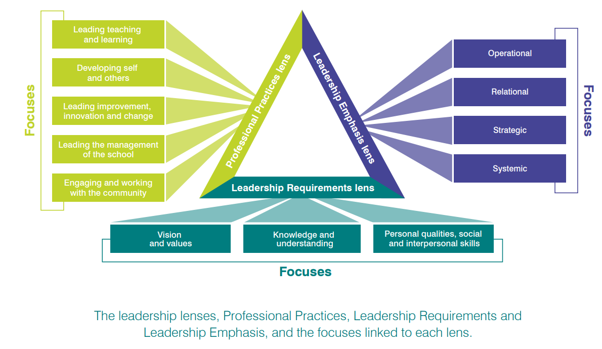

Leading teaching and learning

Developing self and others

Leading improvement, innovation and change

Leading the management of the school

Engaging and working with the community
Focus: Leading teaching and learning
Profile
Developmental pathway: a principal’s increasing proficiency
Step 1
Principals as instructional leaders
Principals ensure the school values underpin
and support high-quality inclusive practices and
set expectations that all activities are focused on
improving student learning outcomes. They keep
up-to-date with and share current developments in
pedagogy and student engagement with all staff. They
lead staff and students in identifying and planning
high-quality teaching and learning.
Step 2
Leading high-quality teaching and learning
Principals prioritise creating and sustaining a
student-centred learning environment. They motivate
staff to keep their teaching practice current through
use of research and new technologies. They develop
a robust approach to reviewing the curriculum and
pedagogy to ensure a consistently high-quality
environment for learning. They develop a coaching
culture that encourages honest feedback to and from
students and teachers based on evidence.
Step 3
Championing student and staff achievement
Principals lead a school-wide focus on individual
student achievement, implementing strategies that
secure educational provision for all. They ensure that
reflective practices, structured feedback, peer review
and use of the Australian Professional Standards for
Teachers lead to personal improvement of both
students and staff. They systematically monitor and
report on student progress and have interventions
in place to reduce gaps in attainment. They
communicate high aspirations and expectations
for all, celebrate success and challenge
underperformance.
Step 4
Inspiring high aspirations through collaborative leadership
Principals lead high aspirations in learning and inspire
the same in students, staff and parents. They establish
systematic methods for collecting and interpreting
evidence to identify excellent teaching and learning,
and share successful strategies with the school
community. They encourage staff to contribute to
education networks, supporting the learning of
others and development of pedagogy. They model
collaborative leadership and engage with other
schools and organisations to share and improve
practice and encourage innovation in the education
system
Focus: Developing self and others
Profile
Developmental pathway: a principal’s increasing proficiency
Step 1
Driving professional growth for school improvement
Principals promote the benefits of professional
learning to all staff and ensure that their willingness
and efforts to learn and improve are recognised. They
develop and implement a personal and organisational
vision that links all learning and development activities
to better outcomes for students. They work with staff to
identify and prioritise their professional learning needs
based on any gaps between the requirements of their
roles and their current knowledge, understanding and
skills. They model personal and professional learning
that is clearly linked to school goals and seek support
from others as appropriate.
Step 2
Fostering leadership and professional development
Principals seek leadership potential in others
and provide opportunities for their development.
They identify and implement professional
learning opportunities with staff that are aligned
with staff learning plans and school priorities.
They consistently apply effective performance
and development processes so that success
is celebrated, underperformance addressed
and complacency challenged. They provide
staff with regular and effective feedback on their
performance, determining together how they can
improve and remove any obstacles to learning.
Step 3
Building a culture of empowerment and wellbeing
Principals build capacity by creating a culture of
empowerment, responsibility and self-directed
research that leads to the development of a
professional learning community. They model
the importance of health and wellbeing, watch for
signs of stress in self and others and take action to
address it. They modify their leadership behaviour
based on learning from experience and feedback
from colleagues. They evaluate whether professional
learning undertaken by self and staff has had the
desired impact on students and has been shared
with others.
Step 4
Mentoring and empowering school leaders
Principals create challenging roles, responsibilities and
opportunities for senior leaders that leverage and grow
their talents. They build and sustain a coaching and
mentoring culture at all levels in the school and have
a system of peer review and feedback in place. They
mentor other principals to support their growth and
development and help them to address issues. They
seek opportunities for professional growth through
engaging in state, national and global educational
developments.
Focus: Leading improvement, innovation and change
Profile
Developmental pathway: a principal’s increasing proficiency
Step 1
Leading innovative school improvement
Principals identify the need for innovation and
improvement that is consistent with the school’s
vision and values and is informed by student learning
outcomes. They communicate the need for change
to the whole-school community in an inspirational
and logical way. They deepen their own knowledge
and understanding of improvement strategies, leading
change and innovation at a whole-school level. They
engage and inspire staff to commit to evidence-based
improvement, change and innovation that has a
positive impact on student learning.
Step 2
Driving effective and sustainable change
Principals develop a process and common language
for change, which supports the implementation of the
vision and strategic plan. They evaluate outcomes
and refine actions as change is implemented, paying
attention to social, political and local circumstances.
They take account of the impact of change on others,
providing opportunities for regular feedback so that
change is owned by the school community. They
distribute leadership and encourage staff to build
consensus across the school community and to take
individual responsibility for implementing change.
Step 3
Sustaining improvement through strategic adaptation
Principals maintain their values whilst adapting
flexibly and strategically to changes in the
environment, in order to secure the ongoing
improvement of the school. They lead and
implement the appropriate use of new technologies
in all aspects of the school’s development. They
build a culture of trust and collaboration where
change and innovation based on research and
evidence can flourish. They embed collaborative
and creative practices in the school, allowing
everyone to contribute to improvement and
innovation.
Step 4
Fostering a culture of continuous improvement
Principals embed a culture of continuous improvement,
ensuring research, innovation and creativity are core
characteristics of the school. They lead educational
networks by trialling and exploring new ideas for the
system, acting as a guide, coach and mentor to staff
and colleagues. They evaluate the personal and
organisational effects of change through regular
feedback from stakeholders and evidence of impact
on student outcomes. They develop an innovative
and outward-focused role as a leader influencing
school excellence across the system.
Focus: Leading the management of school
Profile
Developmental pathway: a principal’s increasing proficiency
Step 1
Aligning school management with vision
Principals align management procedures and
processes to the educational goals and the vision
and values of the school. They ensure employment
practices and decisions are consistent with legislative
requirements. They allocate resources effectively to
maintain the day-to-day operations of the school and
evaluate impact on student outcomes and value for
money. They clarify for staff the relationship between
the school’s vision and values and the operational
tasks that support them.
Step 2
Using data and technology for effective decision-making
Principals embed effective decision-making processes
and build a cohesive leadership team. They analyse
what data is important and plan how it should be
used in the support of student learning outcomes.
They make best use of technology to record, analyse
and share information, to monitor progress against
goals, and support new ways of working. They model
exemplary professional behaviour and promote ethical
standards throughout the school community.
Step 3
Promoting collaborative and strategic management
Principals ensure management procedures are
fully understood by staff who take collective
responsibility for the smooth and efficient running of
the school. They introduce best practice in human
resource management to ensure the school can
attract, retain and motivate all staff. They review and
improve plans regularly with the school’s governing
body so that the school’s vision can be realised.
They use a consultative approach with students, staff
and the wider school community to develop formal
strategic plans.
Step 4
Planning for future trends and accountability
Principals identify trends and influences that will have an
impact upon the management of the school and plan
for them. They review the effectiveness of processes
and use of data to improve school performance.
They share best management practice and use
of resources with other schools and education
networks. They embed a culture of review,
responsibility and shared accountability to achieve
high standards for all.
Focus: Engaging and working with the community
Profile
Developmental pathway: a principal’s increasing proficiency
Step 1
Building inclusive community partnerships
Principals promote parental and carer engagement
as a key aspect of raising the achievement of all
students. They support the development of a strong
school governing body that is truly representative
of the community. They lead an inclusive curriculum
and school culture that promotes understanding of
and respect for Aboriginal and Torres Strait Islander
histories, cultures and languages and other culturally
and linguistically diverse communities. They build
partnerships with the local community and external
stakeholders so they are aware of the vision and values
of the school and can contribute to its success.
Step 2
Engaging with the wider community
Principals draw on expertise from other organisations
to enhance and enrich the learning experience
for students and their families. They encourage
the community to use school facilities in order to
strengthen community engagement with the school.
They identify and implement strategies to meet the
diverse needs of students and their families, challenge
low expectations and close gaps in achievement
for specific groups. They understand the strengths
and needs of their communities, promoting high
expectations and achievement for all.
Step 3
Prioritising student and family wellbeing
Principals work with other agencies to support the
health, wellbeing and safety of students and their
families. They create specific strategies for hard-to-reach parents and carers, and explore the use of
technology to deepen the engagement of parents
and carers in student learning. They establish
innovative processes to gather regular feedback
from families and the local community that is
systematically used to review school practices and
inform decision-making.
Step 4
Leading an inclusive, outward-facing school
Principals lead the school as an inclusive outward facing organisation. They link with and provide support
to other schools in effective community and family
engagement. They draw on best practice nationally and
internationally to embed a culture of inclusion and high
expectations for all and take steps to tackle the effects
of disadvantage on learning. They develop a mutually
supportive, collaborative and trusting relationship
with the community to ensure engagement in the
life of the school. They collaborate effectively with
other schools and agencies to promote an excellent
education system in which all young people can
thrive.