Growing the profession
Australia's early career teachers
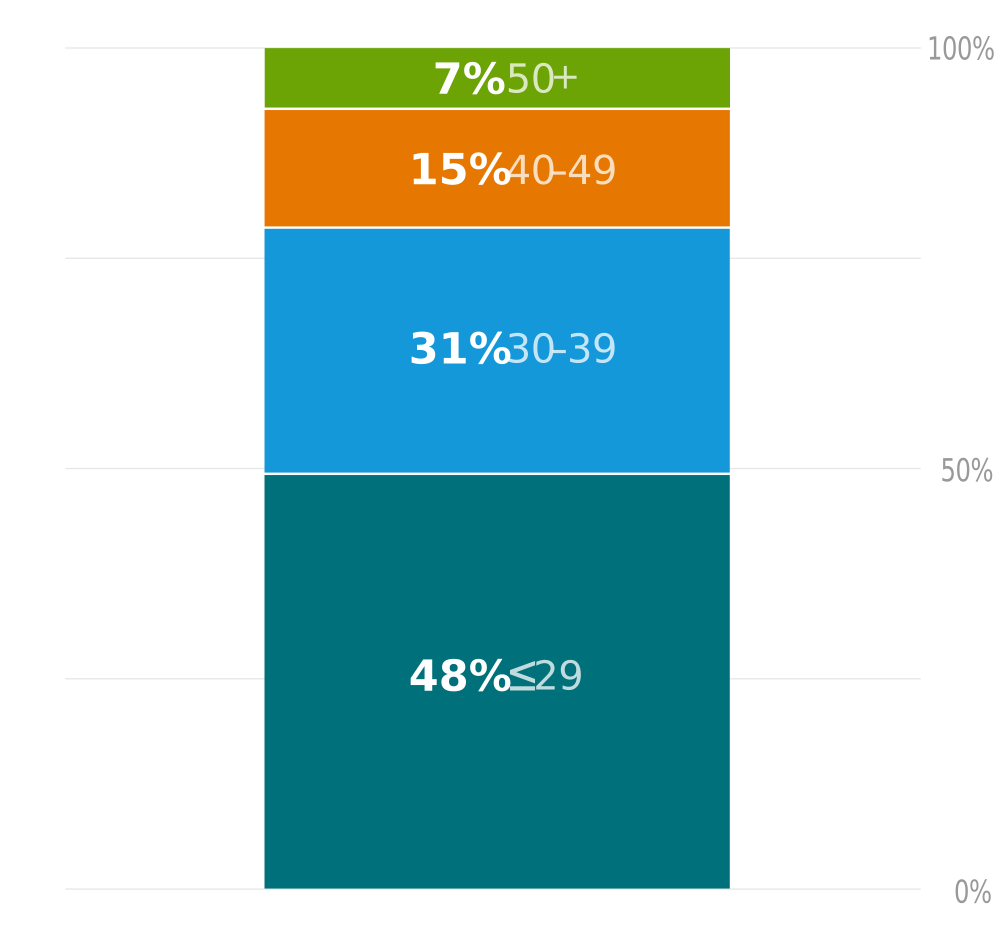
Early career teachers (those in their first 5 years of teaching) make up around 22% of the teacher workforce. Like the overall teacher workforce, most (76%) early career teachers are women. Most early career teachers are young, with around half aged under 30, but some people become teachers later in life: 22% of early career teachers are aged 40 or above. Despite being new to the profession, some early career teachers are in leadership roles: 7% of middle leaders are in their first 5 years of teaching.
Figure 1. Early career teachers’ age
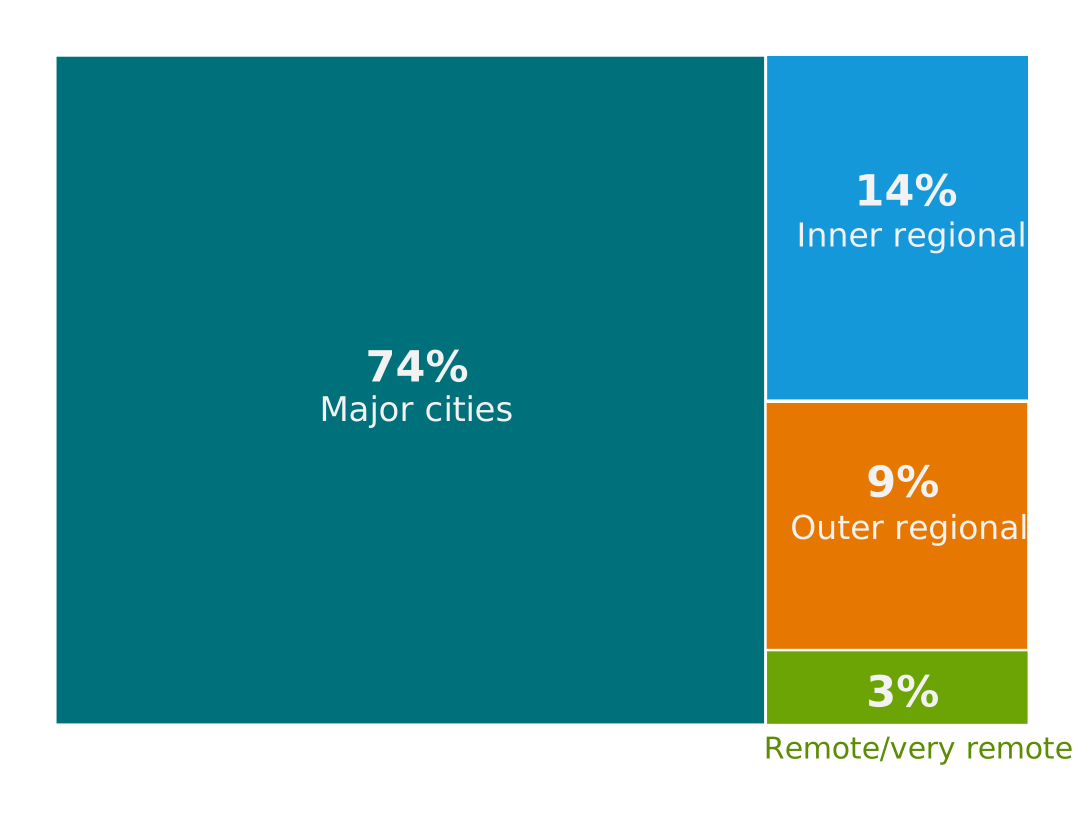
Early career teachers are distributed throughout cities (74%), regional, and remote/very remote areas in similar proportions to the overall teacher workforce.
Figure 2. Regional distribution of early career teachers
Starting out: induction and support
Teachers who are supported in their early career tend to be more effective and more satisfied with their jobs, and thus more likely to remain in the profession.1, 2, 3
A fundamental support for new teachers is a thorough induction. Formal induction is important because it can introduce early career teachers to the school community, working culture and teaching environment, as well as provide support to enhance their individual pedagogy, hone their professional identity, and successfully manage the challenges of their role.
There are some aspects of the job that early career teachers report finding particularly challenging. The annual Australian Teacher Workforce Survey (Teacher Survey) provides valuable insights into some of these challenges. For example, many early career teachers report the emotional load of teaching, and student behaviour management as key causes of work-related stress.4 Further, in line with broader teacher workforce trends, many early career teachers report feeling unsure about their longer-term career intentions (42% in 2024), while some report intending to leave teaching before retirement (38% in 2024). Of the early career teachers intending to leave before retirement, workload and managing student behaviour are commonly cited reasons influencing this intention.5
Given these challenges, it is important to ensure early career teachers are effectively supported with a formal induction, to help them adjust to the rigours of their new role. The Teacher Survey helps us to understand how many new teachers are receiving induction, what type of induction they are receiving, and what parts of induction they find most useful.
For more information on induction, see AITSL’s Guidelines for Induction of Early Career Teachers.
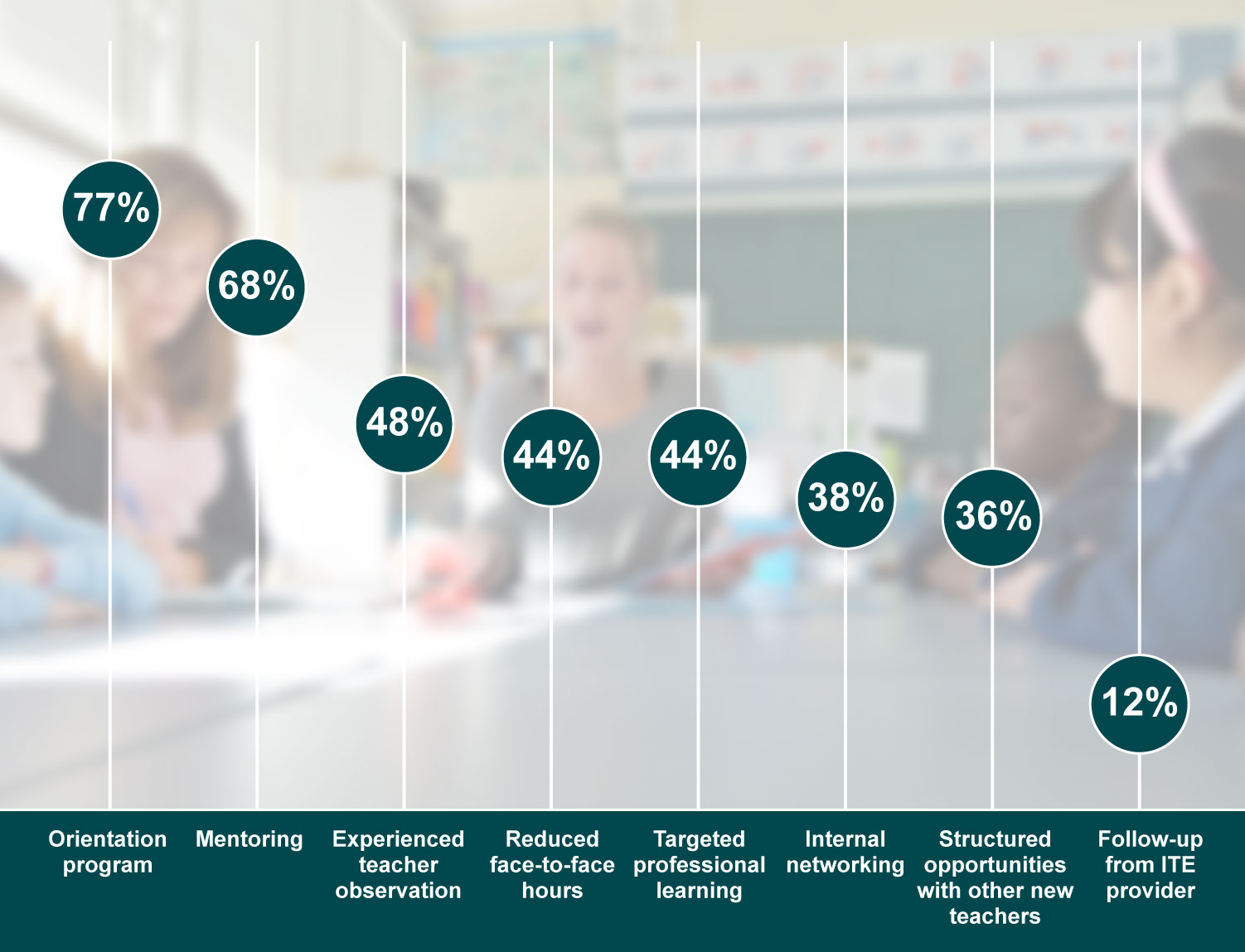
In the 2024 Teacher Survey, 60% of early career teachers deployed in schools or early childhood settings, and 36% of early career casual relief teachers reported receiving a formal induction (56% of early career teachers, overall). Of those who reported being formally inducted, the most common induction activities were an orientation program (77%) and mentoring (68%). Less common were other aspects of induction such as the opportunity to observe experienced teachers (48%), reduced face-to-face teaching hours, or targeted professional learning (44%; Figure 3).
Figure 3. Induction components received (2024)
Learning from experienced teachers is most useful
Early career teachers find some induction supports more beneficial than others. When asked in the Teacher Survey which activities they found most useful, the three most commonly selected activities6 were mentoring, a reduction in face-to-face teaching hours, and observing experienced teachers. Interestingly, while an orientation program is the most commonly delivered induction component, it is not often considered the most useful one.
With both mentoring and spending time observing experienced teachers included in the top three most useful supports, this emphasises just how valuable experienced teachers are for guiding newer generations of teachers. The mentorship provided, and insights gained from observing more experienced teachers, may be particularly helpful for aspects of the job that early career teachers typically find more challenging or stressful, such as managing student behaviour and dealing with the emotional load of the job.7
For detail on what makes a good mentor, see AITSL’s Mentoring Guidelines.
Figure 4. Top three most useful induction components (2024)

Choosing to stay: beyond the first 5 years
Early career teachers are the future of our teacher workforce, and the supports they receive are vital to ensuring they are set up for success. In Australia, most teachers who enter the workforce do remain in the workforce throughout their early career period. While it is often reported that up to 50% of early career teachers leave the profession, the evidence does not support this8 – current Australian estimates put the proportion of early career teacher attrition much lower. Attrition is difficult to measure because teachers may: leave one position and take up another (sometimes moving sector or state/territory in the process); go on leave temporarily or for extended periods; or maintain their teacher registration even after leaving the profession.
The ATWD cannot directly measure teacher attrition. However, it can measure whether ITE graduates remain registered as teachers over time.
Registration retention is related to, but not the same as, teacher retention. Since some teachers leave the profession while maintaining registration, registration-based estimates are likely to understate true attrition. Of the 2024 Teacher Survey respondents who reported that they were not currently working in the teaching profession and not on leave (9.6%), 50% reported that they left the profession 3 or more years ago (but were still registered). Conversely, some teachers who are not currently teaching may return to the profession in future years. Nevertheless, the number of teachers who discontinue registration each year provides some insight into trends in workforce exits. The ATWD connects teachers who were registered in 2024 with the year they graduated from their ITE degree. This shows that:
- around 5% of those who graduate an ITE degree9 were not registered as a teacher in the year after graduation.10
- of those who register, around 2% cease registration during their early career period.
While the rate of actual attrition in the early career period is likely higher than 2% (since some people may opt to maintain registration even after leaving the profession), this is substantially lower than the claims sometimes made in the media of ~50%.
Data outside of the ATWD also debunks the 50% attrition myth. A recent Australian study examined this through administrative tax data that included individuals’ main occupation.11 This, too, is not an exact measure of the number of registered teachers who remain working as teachers, as people do not necessarily update their main occupation in their tax returns each year, resulting in an underestimation of true attrition. However, this analysis showed that:
- around 2.3% of early career teachers leave the profession each year.
- the calculated attrition rates for young12 teachers were estimated to be lower than for young workers in other occupations across Australia, including other female-dominated, demanding, people-facing professions such as nursing.13
Combined, these results suggest that most early career teachers progress through their early years in the profession. As teachers transition into their mid-career period, they continue to build and strengthen their professional expertise. Leadership roles and mentoring responsibilities become more common: 27% of the workforce with 6–9 years of teaching experience are in middle or senior leadership roles. This phase of a teacher’s career offers both new opportunities and a different set of challenges.14 By setting new teachers up for success from the start, we help to set them on the path to grow and thrive throughout their careers, ultimately becoming mentors and leaders for the teachers who follow.

For more information on teachers’ experiences throughout their careers, see National Trends: Teacher Workforce and the Data Portal.