About this publication
Publication details
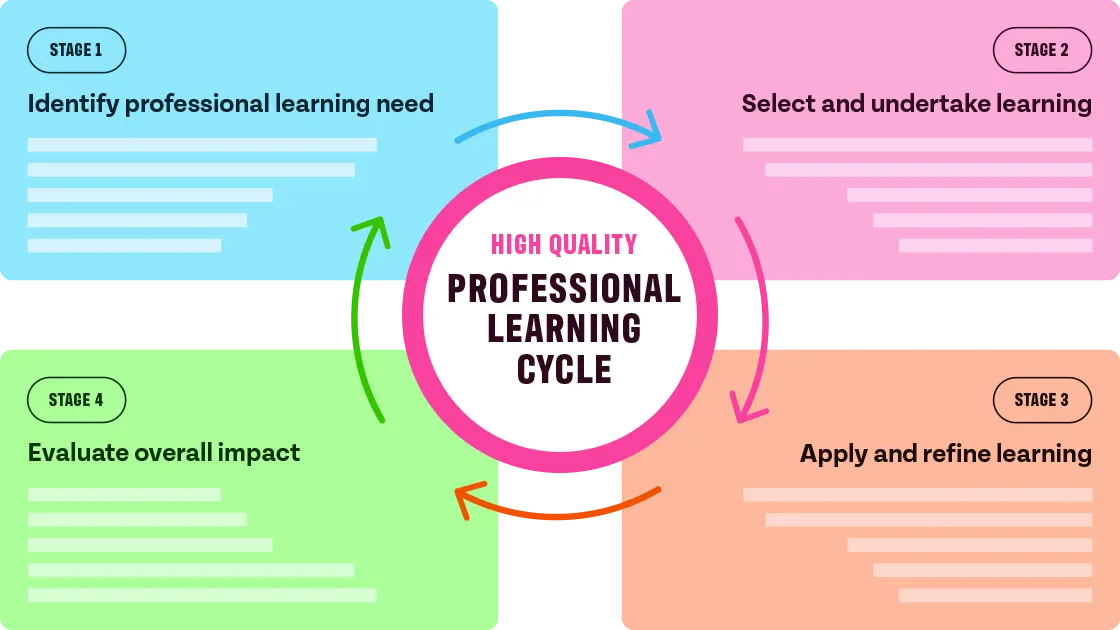
Stage 1: Identifying a professional learning need
Lay the foundation for a high-quality professional learning experience by carefully considering your professional learning needs. This will enable you to select professional learning that’s relevant for you and your context.

Our recommendations
Professional learning needs may be at the individual level, or may apply across a department or entire learning environment.
You may wish to discuss with your colleagues and/or leadership whether there are current opportunities for a more collegial approach to professional learning, based on wider needs.
When determining your professional learning needs, also consider the needs of learners.
If there are particular areas where your learners are struggling, or where you would like to take their learning further, this may indicate an area where professional learning would be helpful.
Resources such as the Teacher Self-Assessment Tool (TSAT) may help you identify your professional learning needs.
The TSAT takes about 25–30 minutes to complete, and will help you determine where your practice sits in alignment with the Australian Professional Standards for Teachers. This can help you narrow down focus areas to target. You may also wish to take the TSAT as part of a group to help you and your colleagues determine professional learning needs more widely in your learning environment.
Discuss your professional learning needs with a mentor or leader.
These colleagues may be in a strong position to help you reflect on your practice and determine your professional learning needs.
Take the time to workshop with colleagues.
Setting aside some time in a staff meeting or planning day can be useful in unpacking both individual professional learning needs, as well as needs across departments or the whole learning environment. Open discussion with colleagues in a positive environment may surface professional learnings needs that could have been missed otherwise. For more information on developing a positive performance and development culture, see AITSL’s professional growth resources TODO.
Refer to the Australian Professional Standards for Teachers and/or the Classroom Practice Continuum (CPC).
Resources such as these provide a valuable framework and common language for discussing teaching practice. Examining these resources, individually or with colleagues, can help you identify where your practice currently sits, and where next you can improve. The CPC in particular can be helpful in your aspirations and goal-setting.
Ask a colleague to observe your practice; or, observe others.
Your colleagues are a valuable source of feedback. By asking a trusted colleague to observe your practice, you can gain an outside view of your strengths, and areas for development. Alternatively, you may wish to observe your colleagues’ practice and take note of areas where you would like to emulate their good practice, or where you think you could improve together. Another option is to video record your practice and watch it later. Find out more about these approaches with AITSL’s classroom observation strategies TODO.
Find out what professional learning your colleagues are doing, either in your own learning environment, or in similar contexts.
Finding out what other teachers are learning may inspire you to change something in your own practice, or highlight a similar need in your context.
Consider what you hope to get out of the professional learning, or what impact you would like to see.
Having a good idea of this before you select and undertake your professional learning will help you with your evaluation later.
Some useful questions to ask when identifying your professional learning needs:
- What do I see my colleagues doing that I would like to learn more about?
- What areas for development do I see in my colleagues/learning environment?
- What aspects of my role would I like to gain more confidence in?
Stage 2: Selecting and undertaking professional learning
It’s important to remember that professional learning can take many forms. There are many types of professional learning besides the conventional conferences and external courses that may be more effective, depending on your learning needs.
It is often most beneficial to engage in professional learning that is collaborative and job-embedded. For example, you may wish to undertake action research; trial and observe new practices with colleagues; engage with a professional learning community; or analyse videos of practice (such as AITSL’s Illustrations of Practice TODO) as a group.
Our recommendations
Engage in a range of professional learning activities for different purposes.
The lists below illustrates types of professional learning. Note that this list is not exhaustive.
Classroom based teaching
- Observation of practice
- Coaching and mentoring
Face to face learning
- Conferences
- School/setting learning event
- Training courses
Formal study
- Post-graduate study
- TAFE certificate/diploma courses
Research
- Professional reading
- Inquiry research
Online Learning
- Modules and courses
- Webinars
- Online Forums
Communities of practice
- Professional learning communities or teams
- Networks
Consider adopting a multi-modal approach when choosing professional learning activities.
Spend more time on professional learning embedded into your daily practice, a proportion of time on undertaking self-directed learning and a small percentage of time attending conferences and formal degree qualifications.
Consider whether you have colleagues who are experts in the area you want to learn more about.
Learning from your expert colleagues, particularly when learning can be job-embedded, is often the most effective way to improve your practice. Learning from your colleagues can also mean lower costs and less time lost to travel, particularly for teachers in rural and remote locations.
Ensure the professional learning you choose is appropriate for/targeted to your career stage.
Many professional learning offerings focus on introductory content that is most appropriate for graduate or early career teachers. While this can be very useful for the audience it’s aimed at, it can be more challenging for more experienced teachers such as Highly Accomplished and Lead teachers (HALTs) to find professional learning that is relevant to their needs.
Discuss the professional learning with your mentor/leader to see if they think the learning is right for you, before undertaking it.
Your trusted colleagues can provide useful feedback in determining whether a professional learning offering will add value for your practice. You may also wish to discuss whether it fits in with priorities in the wider learning environment/system.
Ensure you have appropriate time set aside to undertake and engage with the professional learning.
It may be useful to consult with your leadership as to whether they think the professional learning you wish to undertake will be viable in your context. Some initiatives require considerable time and effort to implement, and this should be discussed up-front to ensure the professional learning undertaken can be applied in your learning environment.
Useful questions to ask
- Does the professional learning connect to my learning goals and the needs of my learners and school/setting?
- Does the professional learning provide me with the tools and support to be applied back in my classroom?
- What opportunities might there be to collaborate with colleagues in this learning?
- What do I already know about this topic? How can I expand this learning?
- What is the evidence base for this professional learning?
- What do I know about the provider (if applicable)? Are they reputable?
Stage 3: Applying professional learning
Application of learning is a core component in an ongoing high quality professional learning cycle. Actively apply your understanding, make revisions to practice, and trial and implement new ideas and approaches at this stage. This may take place in the learning environment with learners, or it may have a stronger impact on your interactions with colleagues.
While a learning design can support implementation, you have the responsibility to decide whether and how to implement a change. Implementation continues the process of your learning. As you monitor the impact of new approaches, or reflect on application of new strategies and skills, the pedagogical part of content learning takes place. As adjustments need to be made, new theoretical knowledge or peer collaborations may be sought.
Our recommendations
Consider your local context.
Don’t feel you have to apply your professional learning exactly as it was presented. You may find your learning more effective if you tweak it to suit your particular circumstances and learning environment.
Look for opportunities to share your learnings with colleagues.
This will support accountability and sustained behaviour change. It will also enable you to scale effective practices.
Seek buy-in from leadership.
Support from leadership is critical in scaling practice and encouraging adoption across the learning environment.
Ask a colleague to observe your practice, note changes, and provide feedback.
This can provide a useful outside view of how the professional learning has led to improvements in practice. Your colleagues may also be able to provide ideas about how to further embed the learning in your practice.
Observe colleagues who are applying the same learning.
Likewise, you may find additional ways to put your learning into practice.
Find out how other teachers tweaked similar learning to fit their context.
This may be the next step in your learning, and applying even more effective practices.
Some useful questions to ask when applying professional learning:
- How can the professional learning be contextualised and tweaked to suit my learning environment?
- Does the professional learning address the identified needs of my learners?
- What further professional learning might I need in this area?
- How can my colleagues/leader support me to implement this learning?
Stage 4: Evaluating overall impact
Evaluating the impact of your professional learning may not always be easy, as it will take time to impact your teaching practice and learner outcomes. Where possible, it can be helpful to collect quantitative or qualitative data to help you identify trends in changes to your practice or learner outcomes. These trends may help you to make valid inferences about the impact of your professional learning.
Our recommendations
Seek feedback from colleagues, learners and/or parents/carers on the impact of your professional learning.
Those who have the most exposure to your teaching will be a valuable source of feedback as to whether your practice has improved, and its impact.
Ensure your evaluation focuses on what matters.
Measurement for measurement’s sake is not necessarily useful; be sure to measure what you value. It’s possible that the impact of the professional learning will be in an area that is not seen as a priority. In such cases, it’s important to be honest and objective in your evaluation so you and your colleagues can select and undertake more relevant professional learning in the future.
Repeat the activities you initially undertook to determine you professional learning need.
Further observations, or taking the Teacher Self-Assessment Tool a again, may help you identify areas where your practice has improved. They may also surface areas for further professional learning.
Some useful questions to ask when evaluating professional learning:
- Was the professional learning appropriate to my career stage?
- Did the professional learning provide value for money?
- Has the professional learning been embedded across the learning environment?
- How did the professional learning make you feel? For example, did you feel more energised in your teaching, or inspired to try a new approach?
- Did the professional learning contribute to an improvement in school culture?
- What support did you receive from your colleagues/leaders?